

Introduction
When we talk about power reliability in a substation, the first thing that comes to mind is the main transformer. But the real story often lies in the background. Many small systems keep the entire setup alive. And this is where a Solar Auxiliary Transformer for Substations becomes important.
At Rameshwar Power Control, we have seen many plants run smoothly only because their auxiliary power never failed. We have also seen sites where a small voltage mismatch in a control panel shut the whole operation. So, this article is written for substation teams who want stable power for their auxiliary equipment. And who want a transformer that works quietly and consistently.
If you want to read more about how stabilizers support industries, you can explore our earlier content on what is a servo voltage stabilizer, voltage drop problems, or industrial stabilizer use cases.
What Is a Solar Auxiliary Transformer for Substations?
Every substation has two types of loads. One is the main load. The other is the support load that keeps everything running. This support load needs steady voltage. Sensitive devices like protection relays, control panels, SCADA, cooling fans, and battery chargers don’t tolerate fluctuation.
A Solar Auxiliary Transformer for Substations provides that steady power. You can think of it like a heart valve. The main transformer pumps energy, but this smaller transformer ensures the pressure is right where it matters. Without it, you may face issues like tripping, alarms, or equipment overheating.
We’ve shared similar insights earlier in our guides on industrial stabilizers, 3 phase isolation transformers, and servo stabilizers for hospitals. Substations have the same need: stable auxiliary supply.
Why Substations Need a Solar Auxiliary Transformer
We have walked into many substations over the years. And the pattern is always the same. The main transformer looks strong and loud. But the auxiliary circuits tell you how healthy the system really is.
Here’s why substations rely on auxiliary transformers:
- Your control systems need precise voltage. Even a small drop can cause errors.
- Cooling units must run constantly. If they stop, the main transformer suffers.
- Monitoring and protection equipment depend on uninterrupted power.
- Battery charging systems need clean input.
- During fluctuations, auxiliary equipment stays safe only when the supply is stable.
If you want to understand voltage stability in detail, our posts on voltage drop problems may help.
Benefits of Using Solar Auxiliary Transformer for Substations
Constant Power for Auxiliary Loads
Your panels, meters, relays, and communication units depend on a clean input. A sudden dip or spike can shut them down. This transformer prevents that.
Voltage Matching for Critical Equipment
Different equipment needs different voltage levels. Auxiliary transformers handle these adjustments without stressing the system.
Better Reliability and Safety
When auxiliary power is stable, the whole station becomes more reliable. Trips reduce. Maintenance reduces.
Ideal for Solar and Renewable Substations
Renewable sites often sit in open, dusty, or hot locations. So the transformer must handle tough conditions.
Our earlier blogs on solar auxiliary transformers for solar plants, wind parks, and industrial plants explain how this works in different sectors.
Built for Harsh Environments
Not every site has ideal conditions. Dust, heat, and remote outdoor locations are common. That is why construction quality and material selection matter.
Applications of Auxiliary Transformers
Solar Power Plants
Plants need stable supply for SCADA, inverter control, string monitoring, and field panels.
Substations
Protection systems, relay panels, annunciators, and emergency lighting all depend on steady auxiliary power.
Wind Parks
Cooling units, turbine communication systems, and safety devices need stable voltage to work properly.
Industrial Power Systems
Automation panels and sensing devices are major auxiliary loads. You can read more in our guides on servo stabilizers for CNC, industrial voltage stabilizers, and stabilizers for textile machines.
Technical Specifications That Matter
Here are the key points engineers should always check. We have learned this from working on real projects, not from theory alone.
- Rating: Up to 100 kVA
- Input Voltage: 800 / 415 / 230 or as per the project need
- Output Voltage: Fully customizable
- Configuration: Three Phase
- Cooling: Air or Oil
- Frequency: 50/60 Hz
- Insulation Class: F or H
- Vector Group: Dyn11 or custom
- Core Material: CRGO for efficiency
- Ambient Temperature: 45°C
- Applications: Power plants, substations, solar plants, wind parks, industrial plants
When choosing a transformer, understanding vector group selection helps.
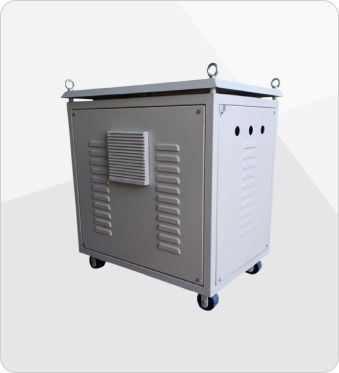
Rameshwar Power Control’s Solar Auxiliary Transformer
Our Experience
We’ve been manufacturing stabilizers and transformers for many years. Most of our work happens in demanding environments. Solar plants, wind parks, remote substations, and high-load industrial units trust us because we stay practical. And we keep things simple.
How We Build It
Our auxiliary transformers are designed to provide stable and precise voltage. They protect critical equipment and support continuous operations. We use CRGO cores, tested materials, and proven designs. This is important when your substation runs in heat, dust, or moisture.
Key Advantages
- Reliable power for auxiliary systems
- Custom voltage options
- Safe operation of main equipment
- Heavy-duty construction
- Air- or oil-cooled options
These strengths match the same philosophy we follow in all our stabilizer products, whether it’s IGBT stabilizers, servo stabilizers for AC plants, or industrial servo systems.
How to Choose the Right Auxiliary Transformer
Here is what we usually tell plant engineers:
- Know your exact auxiliary load
- Check the input and output voltage requirements
- Choose cooling type based on the environment
- Match the vector group with your system
- Consider future expansion
- Check the quality of the core and insulation
- Make sure customization is possible
Conclusion
A Solar Auxiliary Transformer for Substations may look like a small part of the system. But it protects the backbone of your plant. It keeps control circuits stable. It keeps safety devices alive. And it allows the main transformer to work without stress.
If you want a solution that matches your site conditions, Rameshwar Power Control can build it with the right voltage, rating, and configuration. And if you want to explore more contact us.